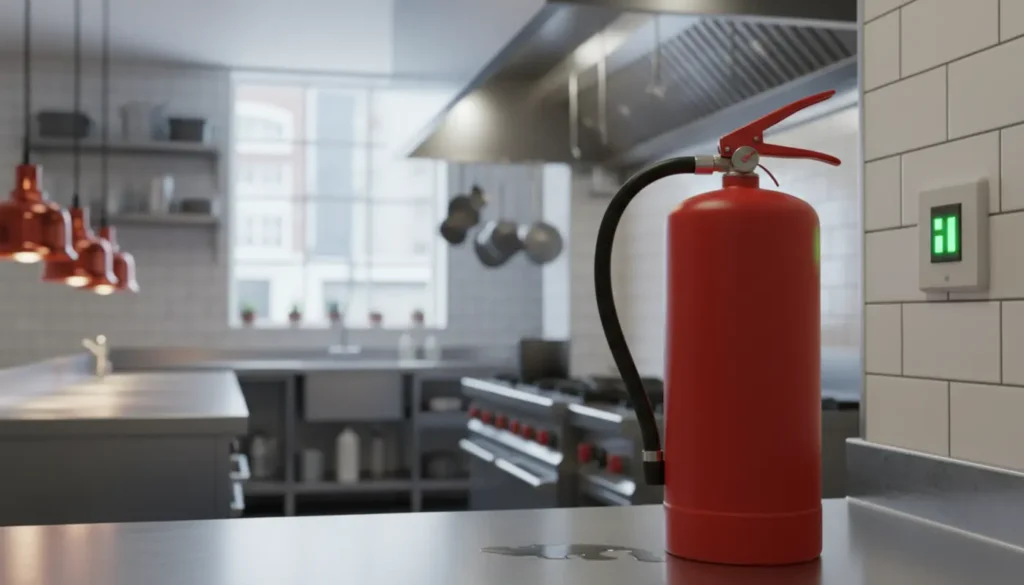
Fire Extinguishers for Care Homes in North West: CQC Requirements
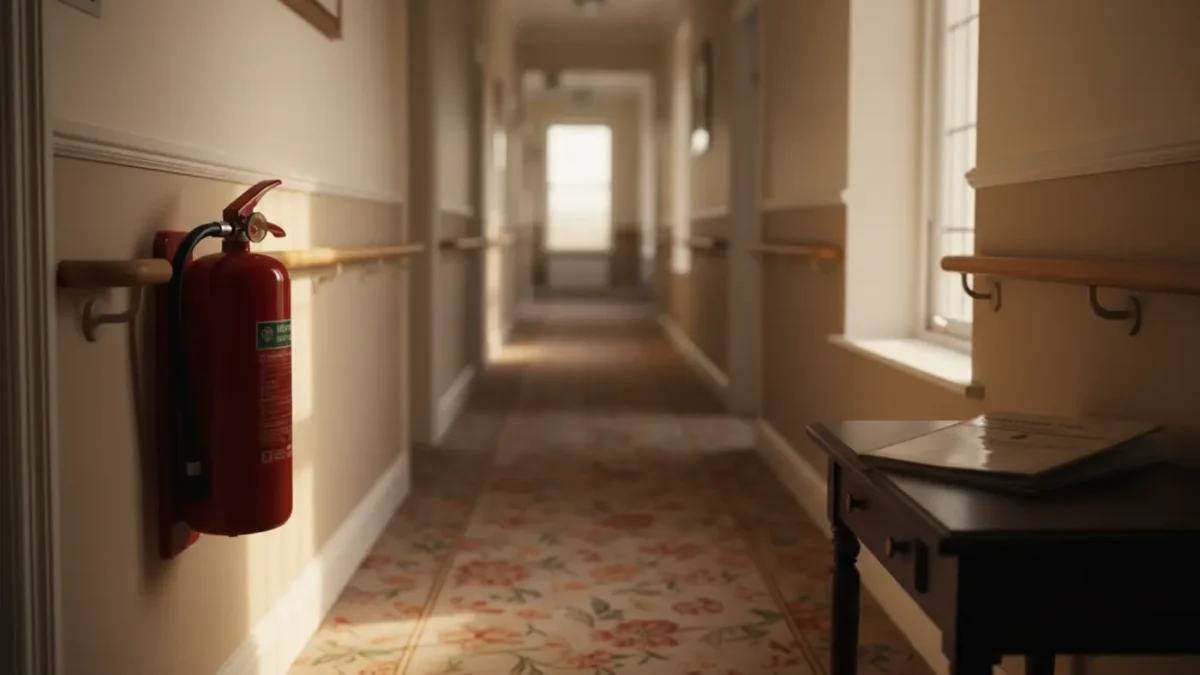
Fire Extinguishers For Care Homes In North West CQC Requirements
Are your fire extinguishers in your North West care home actually compliant with CQC requirements and BS 5306, or are you just hoping no one looks too closely?
Let’s be real. In a care home, fire safety is not a tick box task. You are responsible for people who cannot always get themselves out quickly. That changes everything.
Across the North West, inspections are detailed. CQC looks closely. Local fire services expect standards to be met. Insurers want clear proof, not excuses.
At iSecurity Solutions, we help care providers stay compliant with practical, Insurance Approved fire safety systems under BS 5306. Straight advice. Clear paperwork. Systems that pass inspection.
Why Care Homes In The North West Face Strict Fire Safety Scrutiny
Here’s what’s actually happening. Care homes fall under the Regulatory Reform Fire Safety Order. The registered manager or owner is the responsible person. You must carry out a fire risk assessment and act on it. Not file it away. Act on it.
CQC then asks one key question. Are people safe?
If your extinguishers are out of date, missing, or the wrong type, that answer quickly becomes no.
Government guidance for residential care premises is clear. Suitable fire fighting equipment must be provided and maintained. You can read the official guidance on GOV.UK fire safety guidance for residential care premises.
If you also manage alarms, our guide on fire alarms for care homes in the North West UK explains how BS 5839 Category L1 systems usually apply in this sector.
CQC Inspection Criteria Fire Extinguishers As A Safety Fundamental
Stop pretending extinguishers are just red cylinders on the wall. To CQC, they show whether you take risk seriously.
Inspectors will often check:
- In date service label
- Correct extinguisher types
- Clear wall signage
- Accessible escape routes
- Staff basic awareness
- Up to date risk assessment
- Annual service certificate
If your service label is two years old and faded, what are you expecting? That no one notices the date?
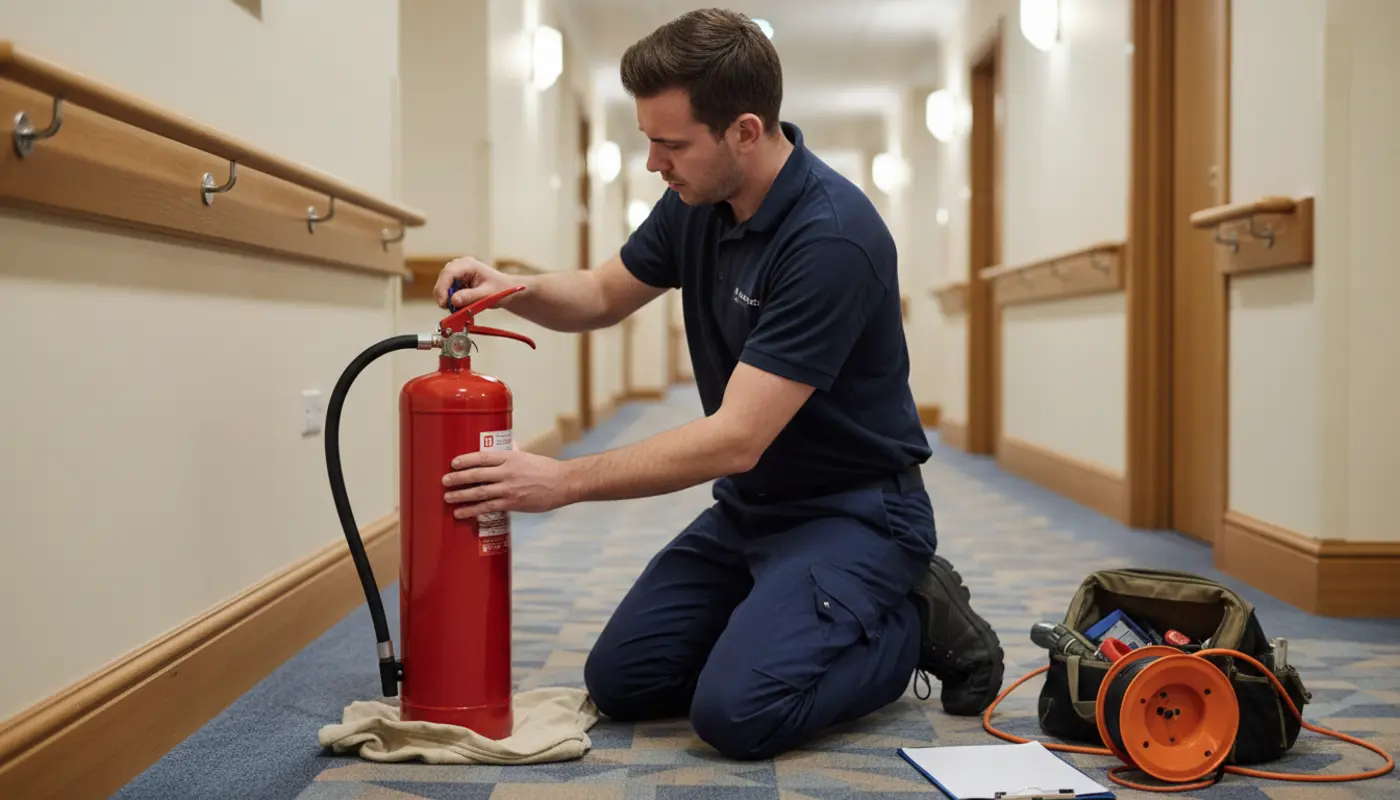
Under BS 5306 and BAFE SP101 scheme rules, extinguishers must receive an annual service by a competent technician. Most insurers expect servicing by a BAFE SP101 registered company under BS 5306. That annual certificate is normally required by insurers and expected by CQC.
Regulatory Reform Fire Safety Order Duties For Registered Managers
Bluntly, if you are the registered manager, you are legally responsible for fire safety.
The Order requires you to:
- Carry out a suitable and sufficient fire risk assessment
- Provide appropriate fire fighting equipment
- Maintain that equipment in efficient working order
- Train staff
- Review arrangements regularly
The law does not give a fixed number of extinguishers. It uses the word appropriate. That means your fire risk assessment decides what is needed.
Would your paperwork survive a surprise inspection? Can you prove every extinguisher has been checked this month?
If you have oxygen storage, commercial kitchens, laundry rooms, or mobility scooter charging areas, your risks are higher than a small office.
If you are unsure what a compliant assessment looks like, our article on fire risk assessment for businesses in Manchester explains what inspectors expect.
BS 5306 3 Compliance Servicing Standards Every Care Home Must Meet
Let’s talk standards. BS 5306 3 covers commissioning and maintenance of portable fire extinguishers. It is the recognised benchmark.
Here is the straight version:
- Monthly visual check by your staff. In place. Not damaged. Gauge in the green. Pin intact. Log it
- Annual service by a competent engineer under BS 5306 and BAFE SP101. You receive a service label and certificate. Keep it filed
- Extended service every 5 years for water, foam and powder units. This includes discharge testing and internal inspection
- CO2 extinguishers require overhaul and pressure testing at 10 year intervals
Miss these intervals and the extinguisher may fail when needed. That is not a risk worth taking in a building full of vulnerable residents.
We explain similar servicing duties in our guide on fire extinguisher servicing legal requirements.
Annual Servicing Vs Extended Service What BS 5306 Requires
People mix this up. Annual service is not the same as extended service.
An annual service checks condition, weight, pressure, seals, hose and label. It is detailed but not invasive.
An extended service goes further. The extinguisher is discharged, opened, inspected inside and refilled or refurbished. That is why it happens every 5 years for most types.
If you cannot show a clear servicing record, CQC will question your management systems. And rightly so.
Water Vs CO2 Vs Foam Choosing The Right Type For Care Settings
Obviously, not all fires are the same.
Water extinguishers are for Class A risks. Bedding, furniture and paper. Most corridors and lounges need these.
Foam covers Class A and some Class B risks. Useful in mixed areas.
CO2 is for electrical equipment. Plant rooms, panels and server cabinets. Water and live electrics do not mix.
Wet chemical is essential in kitchens with deep fat fryers.
Here is the care home reality. Extinguishers are for trained staff and only for small fires. Evacuation and compartmentation, meaning fire resistant walls and doors that slow fire spread, remain the main strategy.
Would your night staff know which extinguisher not to use?
How Many Fire Extinguishers Does Your North West Care Home Need
Cut the nonsense. There is no fixed legal number.
BS 5306 8 gives guidance. At least two Class A rated extinguishers per floor. Around one 13A rating per 200 square metres. Travel distance to a Class A unit should not exceed about 30 metres.
But what really matters is your fire risk assessment.
A three storey 900 square metre home with a commercial kitchen and laundry will need more than a small converted property with 12 residents.
If you are reviewing wider strategy, our care home fire alarm compliance guide explains how BS 5839 Category L1 systems work alongside extinguishers and evacuation plans.
Siting And Signage Rules That Satisfy Fire Risk Assessment Findings
Extinguishers should be on escape routes, near exits and at fire points. Not hidden behind furniture. Not blocked by trolleys.
They must be mounted at the correct height, clearly visible and supported by proper signage. Travel distance guidance under BS 5306 8 should be followed.
Emergency lighting under BS 5266 supports safe access to fire equipment. Monthly flick tests and annual full duration tests are required under BS 5266. If lighting fails during a power cut, your extinguisher location becomes useless.
We explain this further in our emergency lighting guidance.
Staff Training Requirements For Extinguisher Use Under The RRO
Look. An extinguisher is only useful if staff know what it is for and when to walk away.
The Regulatory Reform Fire Safety Order requires appropriate fire safety training. That includes induction, refreshers and recorded fire drills.
Staff should understand:
- How to raise the alarm
- When to attempt to use an extinguisher
- When to evacuate immediately
- The basics of PASS technique
- That resident safety comes first
If a CQC inspector asks a night carer what they would do in a kitchen fire and they shrug, that is a serious issue.
Finding A BAFE Accredited Supplier Across Greater Manchester And Beyond
Not all suppliers are equal. Some attach a label and disappear.
Look for companies working to BS 5306 and certified under BAFE SP101 for extinguisher servicing. Most insurers expect maintenance by a BAFE SP101 registered provider under BS 5306.
Across Greater Manchester, Merseyside, Lancashire and Cheshire, your provider should give clear service reports, asset lists and an annual certificate. Your insurer will expect it. CQC will likely ask for it.
At iSecurity Solutions fire safety services, we design and maintain extinguisher provision in line with BS 5306 and BAFE SP101. Documentation stays inspection ready all year.
Practical Care Home Fire Extinguisher North West CQC BS 5306 Checklist
Here is your checklist:
- Up to date fire risk assessment reviewed regularly
- Correct extinguisher types for each risk area
- Minimum Class A coverage per floor aligned with BS 5306 8 guidance
- Monthly in house visual checks logged
- Annual service certificate under BS 5306 and BAFE SP101
- 5 year extended services and 10 year CO2 overhauls scheduled
- Documented staff fire training and drills
If you cannot tick every box, fix it before your next inspection. Not after.